Paul Pangaro: Rethinking design thinking

Design, says Paul Pangaro in this 2010 PICNIC Festival talk, is a process that begins with the impulse to make thinks better.

As I mentioned in a post on the new film Design + Thinking, I’m using this talk in my systems thinking class, and I’ve started to follow Pangaro’s description of the design thinking process.

What is design thinking? Basically, it’s a process of ethnography, ideation, and iteration. He then suggests clarifying these three steps as: design for conversations, find a focusing problem, and prototype a solution. And he further proposes that we view conversation itself as both means and ends. That is, that we view design as a process of conversation and the goal of design as for conversations among those who will utilize or experience our designs.

See the slides for this talk here.

What I hope is that viewing it this way let’s us think about this process as repeatable, transparent, directed, and measurable. …

The ethical thing, as designers, is to give humans the opportunity to have the conversation they want to have. And ultimately so that they can become their own designers. Designers of their experiences, designers of their preferences, designers of their conversations.

Derek Cabrera, systems thinking, and DSRP

What is systems thinking? — the act of thinking itself, separate from other ways we might approach systems?

“[I] set out to clarify the construct of systems thinking,” writes educational theorist Derek Cabrera in his 2006 dissertation (pdf), “and to define it as a conceptual framework apart from systems science, systems theory, systems methods, and other perceived synonyms.”

Cabrera’s approach takes systems thinking as a “cognitive endeavor,” and distinguishes it from “knowledge-about-systems.”

Compare this approach, for example, with the recent “system praxis framework” diagram, developed by the International Council on Systems Engineering and the International Society for the Systems Sciences, which describes systems thinking as a “practice,” rather than a cognitive act. Is Cabrera’s insistence on a thinking-practice distinction helpful?

The gist of his clarification is this: “Recent work in systems thinking describes it as an emergent property of four simple conceptual patterns (rules),” he and coauthors Laura Colosi and Claire Lobdell write in a 2008 paper (“Systems thinking”), published in Evaluation and Program Planning.

The four conceptual patterns are: distinctions, systems, relationships, and perspectives (DSRP). If information is “what to know,” DSRP is “how to know,” describes Colosi in an online video.

The story of how Cabrera came to the DSRP formulation is itself intriguing. Seeking a pattern of connections across the “tangled overgrowth” of systems literature, Cabrera examined three vast compendiums: the 2003 four-volume set of 76 canonical papers (Systems Thinking) edited by Gerald Midgley, the 2004 International Encyclopedia of Systems and Cybernetics edited by Charles Francois, and the dense 2001 visual map (Some Streams of Systemic Thought pdf), developed by Eric Schwarz and the International Institute for General Systems Studies. Among these, DSRP was “hidden in plain sight,” he and Colosi write in their new book, Thinking at Every Desk: Four Simple Skills to Transform Your Classroom.

The DSRP framework is illustrated by the questions:

  • Distinctions (identity and other): What is __? What is not __?
  • Systems (part and whole): Does __ have parts? Can you think of __ as a part?
  • Relationships (inter and action): Is __ related to __? Can you think of __ as a relationship?
  • Perspectives (point and view): From the perspective of __, [insert question]? Can you think about __ from a different perspective?

The 2008 paper was accompanied by some glowing responses: Deborah Wasserman called it a “gift,” Branda Nowell “significant and innovative,” and Lois-ellin Datta “a sort of Unified Field Theory of Systems Thinking.” References to DSRP on the popular Systems Thinking World Linkedin group are also complimentary.

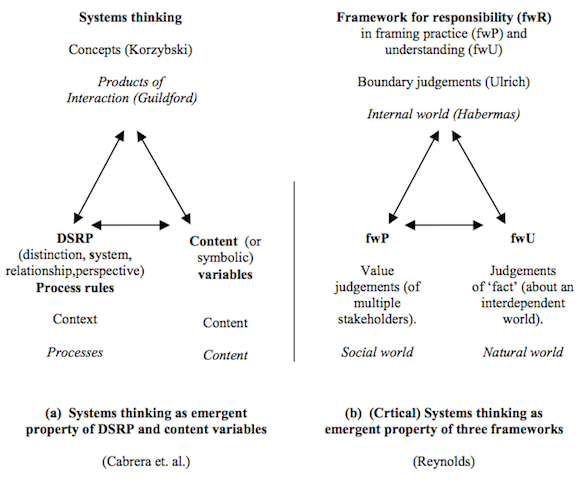
In the book Thinking at Every Desk, Cabrera and Colosi extend the claims for DSRP. Whereas in the 2008 paper, they presented DSRP as a set of processing rules for systems thinking; in the new book, they describe it as a set of universal structures for six types of thinking: critical, creative, interdisciplinary, scientific, systems, and prosocial. In the 2008 paper, they theorized the emergence of concepts from the interaction of content (information) and context (the DSRP processing rules), i.e., concepts = content + context. In the new book, this formula has become: knowledge = information x thinking (DSRP).

A host of questions arise. Could the development of all these types of thinking really be this clear-cut? How does this understanding of “prosocial” thinking relate to, say, the normative and interpersonal competences described by Arnim Wiek and coauthors? How might divergent attributions of knowledge be accommodated or reconciled — this being a frequent goal of the systems practices sidestepped by Cabrera and colleagues?

Responding to the 2008 paper, Gerald Midgley (in “Is there gold at the end of the rainbow?”) wondered if Cabrera and coauthors had come too close to a constructivist view of meaning:

Consider how this work on systems thinking relates to the practice of biophysical science. I believe that, like my own work on systemic intervention (Midgley, 2000), all the D, S, R, and P concepts are directly relevant; their explicitly adoption in scientific methodologies would do a great deal to enhance the critical practice of science. Nevertheless, by framing inquiry in terms of the construction of meaning (conceptualization), there is a danger that scientists will claim that this undermines any talk of biophysical reality. Is there further theoretical work that can be undertaken, perhaps drawing upon pluralist philosophies of science (e.g., Cartwright, 1999) or systems approaches that have sought to welcome scientific methods (e.g., Midgley, 2000; Mingers, 2006)?

And Martin Reynolds (in “Systems thinking from a critical systems perspective”) developed a figure to compare Cabrera and coauthors’ concept of systems thinking with his framework for responsibility:

Much to ponder.

In any event and theoretical considerations aside, kudos to Cabrera and colleagues for their leadership on much-needed educational reform.

Here is the website for Thinking at Every Desk, and below is Derek Cabrera’s October 2011 talk at TEDx Williamsport.

Financing clean energy

How might a clean energy transition be financed? A couple of recent writings describe innovative approaches.

The Capital Institute’s John Fullerton makes a “qualified” case for spending down charitable foundations. After all, he argues, if the risks of a changing climate are as immediate as many scientists fear, these impacts “will overwhelm the good efforts of many other charitable initiatives.”

Could the philanthropic sector have a meaningful impact?

In the US alone, foundation assets now total $600 billion, and an estimated $41 trillion (yes, with a “T”) will transfer to the millennial generation over the coming decades. This financial wealth is built on and dependent upon healthy ecosystem function. Certainly the combined power of this capital, expressed as both outright grants (targeted at everything from policy work, to research and development, to illuminating the numerous promising solutions not yet on the mainstream radar) and high impact investments in the multitude of commercially ready solutions, could potentially break the inertia of business as usual. This power must be concentrated, laser like, on two parallel and complementary strategies at scale: 1) High tech – renewable energy technologies and infrastructure, and 2) High wisdom (to borrow a term from Alan Savory) – restoring the regenerative natural carbon sinks of the oceans, the forests, and the grasslands.

Meanwhile, a new report (“State Clean Energy Finance Banks: New Investment Facilities for Clean Energy Deployment“) from the Brookings-Rockefeller Project on State and Metropolitan Innovation highlights the role of green banks, especially the example of Connecticut’s Clean Energy Finance and Investment Authority.

The Connecticut model reflects the following key design elements:

  • Establishment of a quasi-public corporation, CEFIA, to act as the clean energy finance bank…
  • Consolidation of several existing funding sources into one clean energy finance bank…
  • Authorization to issue special obligations in the form of bonds, bond anticipation notes, or other obligations…
  • Authorization to raise or leverage (through credit enhancements) funds from private sources of capital at an average rate of return set by the board of directors…
  • Authorization to finance up to 80 percent of the cost to develop and deploy a clean energy project and up to 100 percent of the cost of financing an energy efficiency project…
  • Authorization to utilize financing tools such as direct lending, co-lending through public-private partnerships, provision of credit enhancements, administration of commercial property assessed clean energy, and securitization to finance the deployment of clean energy…
  • Strong provisions on transparency, regular reporting to the legislature, and the development of standards to govern eligibility for loans…

In estimating the financial scale of the challenge, the Brookings-Rockefeller report cites Google’s Clean Energy 2030 plan (widely covered in the media in 2008 and published on Google’s Knol website, which is now gone):

One estimate, for instance, concludes that to reduce U.S. fossil fuel-based electric generation by a desirable 88 percent, among other things, by 2030 would require a net investment of $3.8 trillion in undiscounted 2008 dollars.

See also: NRDC’s Switchboard blog on “Clean Energy Finance 3.0 – The Rise of the State Green Banks.”

Slides on history of cybernetics


Cybernetics — from the Greek kybernētēs meaning “steersman” or “governor” — is famously difficult to define or describe.

“The art and science of human understanding,” a definition proposed by Humberto Maturana, is among the dozens listed by the American Society for Cybernetics (ASC).

“I don’t think cybernetics exists, it’s a conglomerate of some subjects which span across completely unrelated areas and it really isn’t treating anything in particular,” laments one Wikipedia contributor on the article’s talk page.

Andrew Pickering, in his book The Cybernetic Brain: Sketches of Another Future, calls it “a nomad science, perpetually wandering and never finding a stable home.”

All said, even the thorniest of ideas have a developmental history, and I came across a charming slide show on “The History and Development of Cybernetics,” originally compiled back in 1982 by students of former ASC president Stuart Umpleby.

The slides are available for download in ten languages here, and they run through java-enabled web browsers here.

What are the benefits of local-regional food?

Last week, I posted a John Ikerd talk on local food relationships as a means to restore national integrity(!). Today I’ll stick with quantifiable stuff.

A 2010 USDA report (“Local Food Systems: Concepts, Impacts, and Issues”) examined the question of local food benefits and found more research needed. Here are their top-line conclusions:

As of early 2010, there were few studies on the impact of local food markets on economic development, health, or environmental quality.
• Empirical research has found that expanding local food systems in a community can increase employment and income in that community.
• Empirical evidence is insufficient to determine whether local food availability improves diet quality or food security.
• Life-cycle assessments — complete analyses of energy use at all stages of the food system including consumption and disposal — suggest that localization can but does not necessarily reduce energy use or greenhouse gas emissions.

We might quibble with these findings, but I am going to pay attention to the study’s questions, not answers.

When we look at local foods in terms of “economic development, health, and environmental quality,” what is our frame of reference? Clearly, this is a sustainability economy-equity-ecology lens.

The USDA deserves kudos for adopting this lens and taking local-regional food systems seriously. But of course any particular lens both reveals and obscures.

Here’s one example of quantifiable benefits that get lost.

A 2008 study (“Regional Farm Diversity Can Reduce Vulnerability of Food Production to Climate Change“) found that greater diversity in farm sizes, types, and intensities — the type of diversity developed through regional production systems — reduced the vulnerability of European wheat crops to projected climate impacts.

This study doesn’t fit the pattern of understanding local-regional food systems in terms of “economic development, health, and environmental quality.” It describes food system resilience, rather than sustainability. And as I wrote about food miles, the two can be quite different.

John Ikerd: Top ten reasons to eat local

What is the local food story? As I wrote yesterday, I think we’re still working it out. Still rationalizing and comprehending an inherently attractive way of being-living-acting in the world.

For agricultural economist John Ikerd, the local food story is first and foremost about integrity. “When we develop those personal connections with each other, around food, then we begin to have personal relationships that are dependent upon integrity.”

I had an opportunity to hear Ikerd speak back in 2005, and secured his permission to publish his talk on the Salmon Nation website.

Here is a reprint:

In preparation for this conference here and as part of the Eat Local Challenge, I came up with my Top Ten list of reasons to eat local.

My ranking reflects the idea that I started with here tonight: that the problems of the food system are deeply rooted within the problems of society. And that we can begin to address these social and ethical problems by eating locally and helping build a local food system.

Number Ten: Some people start with this as the most important, but I put it at the bottom. Eating local eliminates the middleman. Now, eliminating the middleman doesn’t mean that local food will be cheaper. Large food companies minimize their costs by externalizing a lot of their costs onto society and the environment. If you buy from a local farmer who doesn’t do that, it may cost more, but you’re not asking some exploited worker to pay part of your food cost, and you’re not putting it on a charge card for future generations to pick up.

Another Reason: Transportation costs. You know, the average food travels about 1500 miles. But total transportation cost is only 4% of average food cost, so it’s not the economic savings that are important. It’s the fact that you aren’t using up nonrenewable energy in the form of fossil fuel and you’re not polluting the air or putting greenhouse gases into the atmosphere. In other words, it’s the ecological savings, rather that the economic savings.

Number Eight: Eating local improves food quality. Local growers can focus on the varieties, and the harvest times, and things of that nature that maximize the flavor, the freshness, the nutrition, rather than having to concentrate on what they can harvest mechanically, what they can ship across the country, and what will stand up in the grocery store shelves for a week or two or however long it has to stay up there.

Okay, Number Seven: Eating local makes at-home eating worth the time and the effort. Chefs that are focusing on local food will tell you, you don’t have to do much: a minimal amount of seasoning, a minimal amount of cooking. And more important, people preparing their own food can eat at a lower cost than they could eat by buying convenience food. And I think perhaps even more important, preparing food at home, with the family, you bring the family together. I think that food preparation in the home has been labeled — excuse me — ‘women’s work’ and degraded for the explicit purpose of selling convenience in the supermarket. And if we just go back and reclaim the actual value of preparing foods, I think it can do a lot for us.

Number Six: Eating local provides meaningful food choices. You know, people brag about how you can go into the supermarket with this wide variety of foods of all shapes and colors and sizes from all over the world. But you know what, practically all of that is superficial differentiation of foods. It’s packaging, or whatever. Now, by eating local you can get something that’s truly different in terms of variety or quality.

Number Five: Eating local contributes to the local economy. The typical average farmer only gets 20 cents out of each dollar that’s spent in the supermarket. The rest of it goes to marketing. Then, the typical farmer only keeps about 10 to 15 cents of that, the rest goes to fertilizer, feed, and fuel. It’s stuff that goes out of the community again. When you buy it directly from the local farmer, the farmer gets 100% of it.

My Number Four reason: Eating local makes it possible for farmers to continue to farm good productive land. Because if you’re willing to pay the full cost of food, then that makes it possible for the farmer to stay on that piece of land. We’re losing a million acres of farmland a year. You may say, well, that’s not much, but an acre lost to development, covered up in concrete or streets or roads, is an acre lost forever.

Number Three: Reconnecting. We reconnect the farmers with the customers, and the customer, through the farmer, back to the land. The industrial food system depends on impersonal relationships — that’s the only way you can maximize the efficiency is to get people to make impersonal transactions with each other, so that you go to a lower and lower cost level. But by nature, those impersonal transactions end up disconnecting us from each other. That’s the cause of the rising incivility within our society today — crime rates, drug abuse, all of these things are related back to our growing disconnectedness. We’re still as dependent upon the land as we were when we were a society of hunters and gatherers, but our connections are so indirect and complex we don’t realize it. We need to reconnect with the land, and eating local is a critical place to start that reconnecting process.

My Number Two point: Eating local can help us restore integrity to the food system. When we develop those personal connections with each other, around food, then we begin to have personal relationships that are dependent upon integrity. What I mean by integrity is: honesty, fairness, compassion, responsibility, respect. If you’re dealing face-to-face with someone, those things have to be there. That’s what we’ve lost in our food system today. That’s what we need to restore.

My most important reason is: By restoring integrity to the food system, we can begin to restore sustainability to the whole of American society. Through the food that we buy, we begin to see the value of relationships. We see the importance of the earth, of our connection with the earth. We begin to see that the critical problems that we’re facing are a reflection of our disconnectedness. It’s a reflection of the loss of integrity within the system.

Each step that we take toward eating more locally is a step toward a new sustainable society. You say: how can we ever do it, with global corporations, political influence, and all of that. But folks, you know the current food system wasn’t built on a government decree or dictate or fiat or whatever, this system was created one by one.

One by one, as consumers — good consumers — each of us decided they were going to buy something different. We transformed what was a local, connected food system into an industrial, global, disconnected food system. And one by one, we can change this system into whatever we want it to be.

This new food system will be very different from the one we have today. If I had to make my guess as to what it will be, it will be a network of local food systems. We can create a global network of local food systems, but we have to build those local, community food systems one by one. One by one, we can transform the food system into what we want it to be and what we know it ultimately must be.

The new sustainable food system will depend more than anything else upon integrity of relationships. Integrity of relationships depends on the rightness of relationships. And the rightness of relationships is defined within the context of an order that’s higher than us. It’s a recognition that there’s something that transcends us. And that we are part of that bigger thing. And when we act with integrity, we act in harmony with that system.

I would say that eating local may seem like a little thing, but it’s a suggestion that we can begin to create relationships with integrity. And within those relationships, we’ll begin to discover a deeper sense of our responsibility: toward the earth, toward life, toward people. And we’ll begin to understand our responsibility toward something higher than ourselves. And in honesty, fairness, compassion, responsibility, and respect, as we connect, we will connect also not just with each other, but also with the spiritual, the moral. By eating local, by restoring integrity to the food system and to the society, we’ll again arrive at a state on earth that is genuinely human.

Thank you.
Resolving the food miles paradox

Last spring, an in-class presentation by one of my students reminded me that resilience is very different from sustainability.

The topic was food, and the student declared, “Food that comes from New Zealand can be more sustainable than from here in the Pacific Northwest.”

You probably know where this is going. As a proxy for “sustainable,” she was using carbon emissions, and as she described, sea transport can be carbon efficient. So if production practices at home are more intensive than abroad, then the emissions of regional-production-plus-short-distance-transport may be greater than those of international-production-plus-long-distance-transport. Thus, by this logic, imports may be more sustainable. Call it the food miles paradox.

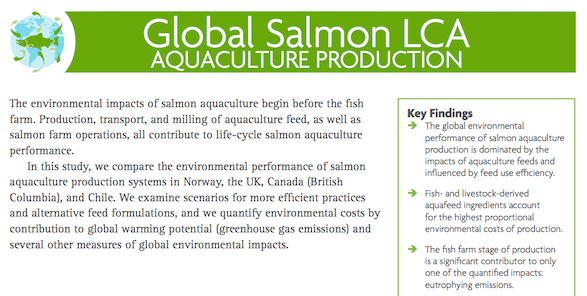
More often than not, the lessons drawn from these types of calculations are used to question the value of local and regional foods, and I’m familiar with such calculations from my work on the salmon life cycle assessment (LCA) project pictured here.

However, I draw a different lesson from the numbers.

Consider this proposition: The local-regional food movement was never about sustainability. That word can be convenient, when its plasticity serves as a boon to conversation. I use the word sustainability all the time — and value it as a boundary object, something to enable communication across language communities, even though various people may have divergent perspectives on its meaning.

The problem is that because food system sustainability is ill-defined, its assertions can lead to paradoxical conclusions, like this one about long-distance food.

Try another proposition: The local-regional food movement is about resilience. It has always been about resilience, even though the word itself is only more recently in common use.

Back to the test case: long-distance food. Not resilient. On the contrary, global supply chains are vulnerable to disruption. (There can of course be other benefits to global food trade, including as a means to alleviate regional shortages or crop failures, and to share nature’s bounties across ecosystems and cultures.)

Food system resilience, including food sovereignty: Is this what the local-regional food conversation has been about all along?

More on the Global Salmon LCA project, my WebVisions talk on using boundary objects to support community formation, and my article “Sustainability: The S-Word

New films about design

The September 20-23 Seattle Design Festival features a fascinating program of documentary films about design.

Critical perspectives inform the Taiwan-made Design & Thinking — such as when Jump Associates’ Udaya Patnaik deflates all hype with the line, “It doesn’t matter what the problem is: I can go in and solve it because I’m a designer.”

Also in the film is Paul Pangaro, whose 2010 Rethinking Design Thinking talk is on the syllabus for my Systems Thinking class, and whose Design & Thinking interview segments are posted on his own site.

Also on screen in Seattle will be The Pruitt-Igoe Myth, a documentary that examines the social and historical context of the infamous St. Louis public housing project. The type of modernist and idealized planning and design that characterized projects like Pruitt-Igoe was roundly criticized in Horst Rittel and Melvin Webber’s 1973 paper on wicked problems.

From the film’s website:

Completed in 1954, the 33 11-story buildings of Pruitt-Igoe were billed as the solution to the overcrowding and deterioration that plagued inner city St. Louis. Twenty years later, the buildings were leveled, declared unfit for habitation. What happened in Pruitt-Igoe has fueled a mythology repeated in discussions of many urban high-rise projects.

The film uses Pruitt-Igoe as a lens through which a larger story about affordable housing and the changing American city can be viewed. It untangles the various arguments about what went wrong in Pruitt-Igoe and dispels the over-simplifications and stereotypes that turned Pruitt-Igoe into a symbol of failure. Second, the film illustrates how conclusions are dangerously and erroneously drawn when powerful interests control debate. History is a contested space. Arguments become flattened, rather than expanded, available evidence discarded, rather than sought. This is why Pruitt-Igoe matters – why we made this documentary.

A third film that caught my attention on the Seattle program is Stephen Kellert and Bill Finnegan’s Biophilic Design: The Architecture of Life. Kellert was co-editor of 1995’s The Biophilia Hypothesis and co-author of 2008’s Biophilic Design: The Theory, Science and Practice of Bringing Buildings to Life.

Interviews include biologist E.O. Wilson, who links aesthetics and evolution: “I think beauty is our word for the perfection of those qualities of environment that have contributed the most to human survival.”

UN report on agroecology

Whenever I hear claims about “feeding the world,” this UN report comes to mind.

From my 19 March 2011 P&P post, reprinted in full:

– – – –

The adoption of agroecological farming practices can double food production in critical regions, says UN Special Rapporteur on the right to food Olivier De Schutter.

From the press release (pdf): “If key stakeholders support the measures identified in the report, we can see a doubling of food production within 5 to 10 years in some regions where the hungry live.”

De Schutter’s concise and readable report, ““Agroecolgy and the Right to Food” (pdf), was presented March 8th at the 16th session of the UN Human Rights Council.

Agroecology, he writes, is both a science and a set of practices.

As a science, agroecology is the “application of ecological science to the study, design and management of sustainable agroecosystems” (Altieri 1995). As a set of agricultural practices, agroecology seeks ways to enhance agricultural systems by mimicking natural processes, thus creating beneficial biological interactions and synergies among the components of the agroecosystem.

He describes three objectives of food systems:

First, food systems must ensure the availability of food for everyone, that is, supply must match world needs. …

Second, agriculture must develop in ways that increase the incomes of smallholders. Food availability is, first and foremost, an issue at the household level, and hunger today is mostly attributable not to stocks that are too low or to global supplies unable to meet demand, but to poverty; increasing the incomes of the poorest is the best way to combat it. Cross-country comparisons show that GDP growth originating in agriculture is at least twice as effective in reducing poverty as GDP growth originating outside agriculture (World Bank 2007; Alston et al. 2002). …

Third, agriculture must not compromise its ability to satisfy future needs. The loss of biodiversity, unsustainable use of water, and pollution of soils and water are issues which compromise the continuing ability for natural resources to support agriculture. …

The primary sources for De Schutter’s conclusion about a doubling of production yields are two papers lead authored by University of Essex Pro-Vice-Chancellor of Science & Engineering and Sustainability & Resources Jules Pretty.

From “Resource-Conserving Agriculture Increases Yields in Developing Countries,” published in 2006 in Environmental Science & Technology:

Here we show the extent to which 286 recent interventions in 57 poor countries covering 37 M ha (3% of the cultivated area in developing countries) have increased productivity on 12.6 M farms while improving the supply of critical environmental services.

The average crop yield increase was 79% (geometric mean 64%). All crops showed water use efficiency gains, with the highest improvement in rainfed crops.

From “Sustainable intensification in African agriculture,” published 2011 in International Journal of Agricultural Sustainability:

Foresight (UK Government Office of Science Foresight project) commissioned analyses of 40 projects and programmes in 20 countries where sustainable intensification has been developed during the 1990s-2000s.

The cases included crop improvements, agroforestry and soil conservation, conservation agriculture, integrated pest management, horticulture, livestock and fodder crops, aquaculture and novel policies and partnerships. By early 2010, these projects had documented benefits for 10.39 million farmers and their families and improvements on approximately 12.75 million ha.

Food outputs by sustainable intensification have been multiplicative – by which yields per hectare have increased by combining the use of new and improved varieties and new agronomic-agroecological management (crop yields rose on average by 2.13-fold), and additive – by which diversification has resulted in the emergence of a range of new crops, livestock or fish that added to the existing staples or vegetables already being cultivated.

De Schutter identifies five principles for scaling up agroecological practices, yet cautions that “the following principles should be applied with flexibility,” and “the move towards agroecology should be based on the farmers themselves – its main beneficiaries.”

The five principles (descriptions shortened, without ellipses):

Prioritizing public goods: Agroecological practices require the supply of public goods such as extension services, storage facilities, rural infrastructure (roads, electricity, information and communication technologies) and therefore access to regional and local markets, access to credit and insurance against weather-related risks, agricultural research and development, education, and support to farmer’s organizations and cooperatives.

Investing in knowledge: Agroecology is knowledge-intensive. It requires the development of both ecological literacy and decision-making skills in farmer communities. Investments in agricultural extension and agricultural research are key in this regard.

Strengthening social organisation by co-construction: Agroecological practices are best adopted when they are not imposed top-down but shared from farmer to farmer. Extension services play a key role in favouring the scaling up of agroecology. An improved dissemination of knowledge by horizontal means transforms the nature of knowledge itself, which becomes the product of a network.

Gender empowerment: Specific, targeted schemes should ensure that women are empowered and encouraged to participate in this construction of knowledge.

Organizing markets: Farmers should also be encouraged to move up the value chain by adding value to raw products through assuming increased roles in packaging, processing, and marketing their produce. Cooperatives can help them achieve economies of scale to facilitate adding value.

Cities and biodiversity

The U.N. Convention on Biological Diversity has posted a second review draft of a forthcoming report on cities and biodiversity. Entitled “A Global Assessment of the Links between Urbanization, Biodiversity, and Ecosystem Services,” the report includes a strong list of “key messages,” each of which is elaborated in this draft:

  • Urbanization is both a challenge and an opportunity to manage humanity’s ecological footprint.
  • Rich biodiversity can exist in cities.
  • Biodiversity and ecosystem services represent critical natural capital.
  • Urban ecosystems significantly improve human health.
  • Incorporating biodiversity and ecosystems in urban planning and design helps reduce carbon emissions and enhance adaptation to climate change.
  • Food and nutrition security depend on local and biodiversity-based food systems.
  • Ecosystem functions must be integrated in urban policy and planning.
  • Successful management of biodiversity and ecosystem services includes all levels and all sectors.
  • Cities offer unique opportunities for learning and education about a resilient and sustainable future.
  • Cities have a large potential to generate innovations and governance tools and therefore can — and must — take the lead in sustainable development.

H/t to Timon McPhearson’s recent article on the group blog The Nature of Cities.