Exxon Mobil: We will adapt to this

The Council on Foreign Relations posts the transcript of a fascinating talk by Rex Tillerson, Chairman and CEO of Exxon Mobil Corporation, entitled: “The New North American Energy Paradigm: Reshaping the Future.”

Tillerson advocates for North American energy security, based on a Mexico-Canada-U.S. joint commitment to increased production. His talk serves as a reminder that the case for climate action cannot be framed on energy security alone.

This part from the Q&A, a question about climate:

TILLERSON: Well, let me — let me say that we have studied that issue and continue to study it as well. We are and have been long-time participants in the IPCC panels. We author many of the IPCC subcommittee papers, and we peer-review most of them. So we are very current on the science, our understanding of the science, and importantly — and this is where I’m going to take exception to something you said — the competency of the models to predict the future. We’ve been working with a very good team at MIT now for more than 20 years on this area of modeling the climate, which, since obviously it’s an area of great interest to you, you know and have to know the competencies of the models are not particularly good.

Now you can plug in assumptions on many elements of the climate system that we cannot model — and you know what they all are. We cannot model aerosols; we cannot model clouds, which are big, big factors in how the CO2 concentrations in the atmosphere affect temperatures at surface level. The models we need — and we are putting a lot of money supporting people and continuing to work on these models, try and become more competent with the models. But our ability to predict, with any accuracy, what the future’s going to be is really pretty limited.

So our approach is we do look at the range of the outcomes and try and understand the consequences of that, and clearly there’s going to be an impact. So I’m not disputing that increasing CO2 emissions in the atmosphere is going to have an impact. It’ll have a warming impact. The — how large it is is what is very hard for anyone to predict. And depending on how large it is, then projects how dire the consequences are.

As we have looked at the most recent studies coming — and the IPCC reports, which we — I’ve seen the drafts; I can’t say too much because they’re not out yet. But when you predict things like sea level rise, you get numbers all over the map. If you take a — what I would call a reasonable scientific approach to that, we believe those consequences are manageable. They do require us to begin to exert — or spend more policy effort on adaptation. What do you want to do if we think the future has sea level rising four inches, six inches? Where are the impacted areas, and what do you want to do to adapt to that?

And as human beings as a — as a — as a species, that’s why we’re all still here. We have spent our entire existence adapting, OK? So we will adapt to this. Changes to weather patterns that move crop production areas around — we’ll adapt to that. It’s an engineering problem, and it has engineering solutions. And so I don’t — the fear factor that people want to throw out there to say we just have to stop this, I do not accept.

I do believe we have to — we have to be efficient and we have to manage it, but we also need to look at the other side of the engineering solution, which is how are we going to adapt to it. And there are solutions. It’s not a problem that we can’t solve.

Source >>

Anthony Leiserowitz, director of the Yale Project on Climate Change Communication has new new paper, coauthored with Nicholas Smith, exploring affective reactions to global warming.

From the paper, “The Rise of Global Warming Skepticism: Exploring Affective Image Associations in the United States Over Time“:

[R]esearchers have focused on the role of “affect,” or the emotional quality of “good” or “bad” associated with different risks. This research has found that people draw upon both affect and other emotional cues to process information and make decisions about risk. Whereas the “risk as analysis” paradigm emphasizes the use of cognitive deliberation to assess risk, the “risk as feelings” approach argues that people are often more reliant upon affect and emotion when making risk judgments and decisions. Affect is processed quickly, automatically, and efficiently and enables people to make daily decisions with relatively little cognitive effort.

In an email, Leiserowitz writes:

In the past decade, the images and feelings Americans associate with the term “global warming” have shifted dramatically. …

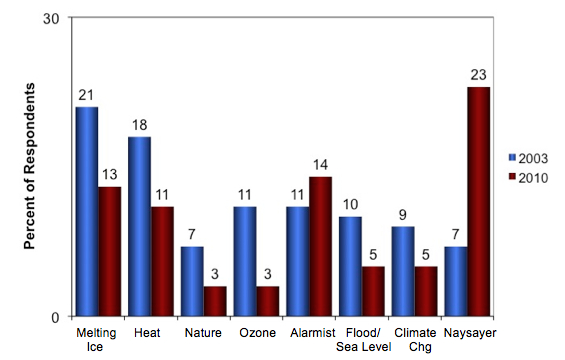
In 2003, only 7% of Americans provided “naysayer” images (e.g., “hoax,” or “no such thing”) when asked what thought or image first came to mind when they heard the term “global warming.” By 2010, however, 23% of Americans provided “naysayer” images. …

The graph below summarizes how Americans’ associations to “global warming” changed from 2003 to 2010.

From the paper:

More specifically, the current investigation found that respondents who held an egalitarian worldview were more likely to perceive global warming as a serious threat whereas respondents who held an individualist view were more likely to perceive global warming as low risk. This finding also corroborates prior research that has used worldviews to predict global warming risk perceptions and policy preferences, among other issues.

I wrote about these two worldviews, as well as others, in an article on “Climate, Worldviews and Cultural Theory.”

Ray Ison: The travesty of targets

I’ve been reading through a couple of chapters of Ray Ison’s 2010 book Systems Practice: How to Act in a Climate Change World, courtesy of downloads offered by The Open University.

“What seems clear to me is that the pervasiveness of systematic thinking and practices associated with goals, targets and projects … does not augur well for adapting in a climate change world,” he writes. “We need to invent something better.”

The “travesty of targets” is that they:

  •   Are seldom institutionalised in an adaptive manner that is open to revision as the situation evolves;
  •   Are easy to develop but much more difficult and expensive to monitor and police; and
  •   Preclude context-sensitive local design in relation to situations or issues of concern.

A chapter sidebar reprints a 2009 article from The Observer, “This isn’t an abstract problem. Targets can kill,” by Simon Caulkin:

The Health Commission’s finding last week that pursuing targets to the detriment of patient care may have caused the deaths of 400 people at Stafford between 2005 and 2008 simply confirms what we already know. Put abstractly, targets distort judgment, disenfranchise professionals and wreck morale. Put concretely, in services where lives are at stake – as in the NHS [National Health Service] or child protection – targets kill.

H/t: Mike Jones

Ray Ison on science in the Anthropocene

Much discussion of this spring’s Planet under Pressure conference, which sought to “provide scientific leadership” in the run-up to Rio+20, was dominated by the brouhaha over planetary boundaries.

But I recently caught a more interesting piece: a post-conference article by The Open University systems professor Ray Ison, who — in his commentary on the conference declaration — offers insight on the practice of science in the Anthropocene.

A few of Ison’s points:

  • There is a lack of reflexivity on the part of scientists themselves. Multiple perspectives including social scientists are needed to frame the research questions and agendas; more than lip-service needs to be paid to inter and trans-disciplinary research approaches (there is a need for significant institutional reform); the linear knowledge transfer paradigm needs to be abandoned in favour of knowledge co-production.
  • There is a need for more conceptual rigour – sustainability is not a state but an ongoing process; targets distort practice and produce perverse outcomes; the language of ‘solutions’ is inadequate in terms of the nature of the situations that have to be dealt with and implies science can deliver panaceas – this is not the case.
  • The need for systemic understanding and practice was highlighted throughout the conference but too often this was confused with systematic (see, for example, this explanation) and also too often people’s comments and framings suggested a lack of systemic sensibility (contextual and relational thinking and practice).
  • We need to abandon triple bottom line approaches and framing and state clearly that the economic is merely one aspect of being social – and a domain where innovation has to happen.

More at his post on “Planet Under Pressure.”

IBM: System of systems

In David Ing’s presentation for the upcoming International Society for the Systems Sciences conference, I caught reference to a 2010 IBM report on systems of systems (“The world’s 4 trillion dollar challenge: Using a system-of-systems approach to build a smarter planet“).

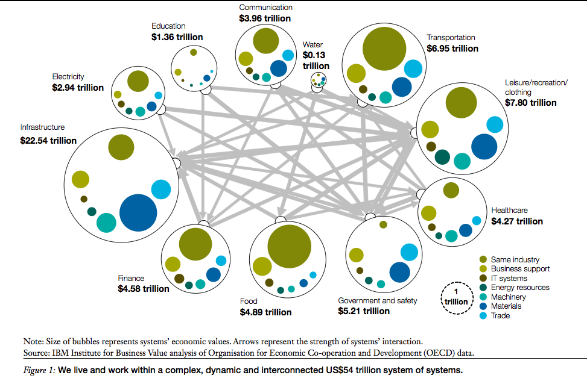
At a fundamental level, our world consists of 11 core systems (see Figure 1). Each system has evolved over time to serve a specific need or want of society. Collectively, they form a global system of systems, representing 100 percent of our worldwide gross domestic product (GDP).

Each individual system is an amalgamation of public and private sector organizations that span multiple industries. For example, Healthcare includes doctors, hospitals, pharmacies, insurers, researchers, drug manufacturers and more – all the entities that contribute to keeping people healthy, whether government-sponsored or private enterprise.

The report is well worth a look. This understanding of global societies as a system of systems is extremely powerful. And it may be the case that this depiction of 11 systems covers 100 percent of GDP, but that does not mean that this depiction is necessarily the correct one.

Some regrouping of data might be valuable. For example, given the importance of energy, it’s helpful to see the transportation and electricity systems split out. I’d similarly like to see thermal energy described separately. Also, farming is a very different system from fisheries, even though both supply food.

More fundamentally, using GDP as the sole metric of a system’s contribution undervalues social and social-ecological systems that are not as prominent in the formal economy. One example would be religion. Another is forestry, which may be but a small component of infrastructure, but can play a big role in habitat destruction or stewardship, depending on forest management practices. The water system in the figure is depicted as having significant outgoing interactions, reflecting its economic contributions, with multiple systems. Yet, in fact, global estimates find that roughly 70 percent of water use goes to agriculture. I suppose these contributions are not as monetarily valuable. [Update: More likely because I should recall that not all agriculture is edible. Thus the arrow from water to clothing.)

Other questions are of course outside the systems boundary of the report itself. For example, whom do these systems serve? How important are equity considerations? Do these systems enable development of individual and social capacities? Can these systems be sustained, given human dependence on nature’s resources and ongoing flows of services?

Jobs and wellbeing

Work is pain; money is pleasure. Or so mainstream economic theory would have it. But our experiences don’t quite match the theoretical models.

Picture the proverbial old guy who just couldn’t retire. Turns out, he’s not that odd. People value the activities of production along with the joys of consumption. And each in nuanced ways.

Research on subjective wellbeing — how we each experience the quality of our lives — is expanding greatly. In this post, I scan the wellbeing literature as it relates to work. And find some surprises.

A pioneer in this field has been Yale political scientist Robert Lane. Here is Lane, from his 1992 paper, “Work as ‘disutility’ and money as ‘happiness’: Cultural origins of a basic market error”:

The market economists’ hedonic equation, namely, money and leisure are the pleasures that reward people for the pain of work, has been shown in recent research to be erroneous. Beyond a decent minimum, increased income contributes little to happiness (subjective well-being) and often a person’s actual working activities are enjoyed more than are leisure activities. Achievement at work is a much more important source of happiness than is a high standard of living. But market institutions and market economics cannot accommodate the idea that work is rewarding in itself or that money is not the principal source of utility.

And from his 1991 book, The Market Experience:

The premise of this book is that the market should be judged by the satisfactions people receive as a consequence of their market experiences and by what they can learn from them. I would substitute these criteria for the current criterion: efficiency in producing and distributing goods and services.

The UK-based new economics foundation (nef) has been a leader in compiling and interpreting wellbeing research. On the subject of work — or, conversely, unemployment — here key findings from their April 2012 report, “Well-being evidence for policy: A review” (pp.20-23):

  • Compared to their employed counterparts, unemployed people have lower well-being.
  • The loss of well-being far exceeds that expected from the reduction in income from unemployment.
  • Although some people with lower well-being may be more likely to become unemployed, these ‘selection effects’ do not explain the size of the relationship between unemployment and well-being.
  • Unemployment also affects the subjective well-being of those who are employed and live in regions with higher unemployment rates.

This last point should come as no surprise. The social pressures of joblessness are broadly felt in the U.S., let alone in countries with double-digit unemployment.

Given these growing understandings about the importance of work for personal and social wellbeing, what needs to change? Obviously, a greater focus on jobs, as we’ve been hearing from all sides of the U.S. political spectrum. How about deeper institutional changes? What would they look like?

One approach is job sharing or flexible work arrangements — basically, working less individually so that available opportunities are spread more broadly.

nef has been an advocate in this area as well. “A ‘normal’ working week of 21 hours could help to address a range of urgent, interlinked problems,” they write, including: “unemployment, over-consumption, high carbon emissions, low well-being, entrenched inequalities, and the lack of time to live sustainably, to care for each other, and simply to enjoy life.”

Economists and advocates Juliet Schor (“The 80% solution”) and John de Graaf and David Batker (“Americans Work Too Much for Their Own Good”) offer similar arguments.

The Netherlands is the poster child for workplace flexibility, referenced by both Schor and de Graaf-Batker. There, workers’ rights to part-time work are the law of the land (details here).

I’ve been sympathetic to these arguments. To be sure, current levels of social inequity are harmful, and ecological conditions are looking risky. “Slow down and smell the roses” seems like very good advice.

Yet, the nature of work is anything but simple, and so I was intrigued to come across a somewhat divergent case, discussed by University of British Columbia economist John Helliwell, who was lead editor on the recent UN-commissioned World Happiness Report.

In a 2011 paper, “How Can Subjective Well-Being be Improved?” (pdf), Helliwell looks approvingly — not at the Netherlands, but — at Korea.

He praises the South Korean response to the 2008 financial crisis:

In 1997-98, facing a … large drop in the external value of the won, South Korea instituted very tight monetary and fiscal policies, leading to sharp drops in consumption and employment [i.e., austerity — ed.]. This was a conventional package, at the time, for a country with a currency under external pressure.

Between then and 2008, it was recognized that the predominantly growth-oriented economic policies were not producing correspondingly better lives. Per capita incomes had indeed increased several-fold over the preceding twenty years but reported satisfaction with life was declining. When the 2008 crisis hit, a new strategy was constructed. It had features that could be taken straight from an SWB [subjective wellbeing] playbook.

Recognizing the high SWB costs of unemployment, the government acted to encourage both public and private employers to maintain employment, and to use their temporarily spare capacity to design and implement industrial changes for a Green Korea. “The ‘grand social compact’ which was agreed to in February 2009 set a guideline according to which the social partners should negotiate employment retention as a quid-pro-quo for wage concessions” (OECD 2009 pdf).

The Korean formula, in a nutshell: the largest fiscal stimulus package among OECD countries, coupled with a “grand social compact” to keep people working and avoid layoffs, in exchange for worker agreement to wage cuts (OECD 2009 pdf). Today, Korean unemployment is at 3.4 percent, down near pre-crisis levels (OECD 2011 pdf), and the lowest among the 34 OECD countries (OECD 2012 pdf).

It’s worth noting that in Helliwell’s praise for Korea, he continues to cite GDP as a measure of social and economic success — whereas nef and others engage in campaigns against the legitimacy of the standard measure.

Still, check this out. On the nef Happy Planet Index — which combines metrics for wellbeing, life expectancy, and ecological footprint — Korea gets a score of 43.8, slightly better than the Netherlands‘ 43.1 (and ahead of the U.S.’s 37.3).

Food for thought.

Image source: UN-commissioned World Happiness Report

Most popular articles on P&P

I did a Google Analytics look back at my old blog, People and Place.

Here is a list of its all-time most viewed articles:

  • Resilience Thinking (by Brian Walker)
  • Six Habits of Highly Resilient Organizations (by Peter+Trudy Johnson-Lenz)
  • Four Types of Goods
  • Climate, Worldviews and Cultural Theory
  • Collapse and Renewal (by Buzz Holling)
  • Adaptive Cycle
  • Luis Bettencourt and Geoffrey West: Cities as Complex Systems
  • “One Person, One Share” of the Atmosphere (by Peter Singer)
  • Russell Ackoff: From Data to Wisdom
  • Tim Flannery: Montreal Protocol Day
  • Climate Adaptation for Resilient Communities
  • Mike Hulme: Why We Disagree about Climate Change
  • The Ethics of Geoengineering (by Dale Jamieson)
  • Glossary of Climate Adaptation and Decision-Making
  • Douglass North: Institutions and Social Transformation
  • Mitigation and Adaptation
  • Panarchy
  • Talking about Design for Resilience
  • Panarchy and Pace in the Big Back Loop
  • Sustaining Our Commonwealth (by Herman Daly)
  • Beth Noveck: Wiki-Government
  • Citizen Science and Social Learning
  • Boris Worm and Ray Hilborn: Rebuilding Global Fisheries
  • Sustainability: The S-Word
  • Rigidity and Poverty Traps
  • Michael Tomasello: Why We Cooperate

John Ralston Saul: Our contemporary NGO army

John Ralston Saul does not mince words.

We are lost in a “maze of logic,” in which “solutions are the cheapest commodity of our day,” Saul wrote in 1992’s Voltaire’s Bastards: The Dictatorship of Reason in the West.

In this summer’s Adbusters, issue #102 on spiritual insurrection, the PEN International president turns his sights on the failures of the environmental movement, “our contemporary NGO army.”

Our reality is that several generations have refused to imagine themselves as making changes. Instead, in the role of the angry outsiders, they have called for the people they do not respect to make the changes on their behalf. This is the traditional role of writers, including of course journalists, not of the engaged population as a whole. You could call this a strategic error with enormous political consequences.

Along with this there was a belief that experts with facts would shape the debate, giving the NGOs support, and so force the hand of power.

That was to misjudge the endless number of facts. Endless and shapeless. And to forget the ease with which such a jumble could create any argument or simply create a confusion which would make action impossible.

Ethics can serve the public good, as can humanist ideas, as can a clear belief in that public good. Facts and expertise are just as likely to be the whores of interest groups, whether public or private, as they are to serve the public good. This was the second strategic error.

And it leads to the third, but also to an opportunity for profound change.

More >> “Canada’s Spiritual Quest: Learning to imagine ourselves”

Regime landscapes and transformation

What comes to mind when you hear the phrase regime change? Donald Rumsfeld and Iraq? Or maybe some kind of popular uprising or coup d’état?

That’s the usual understanding: the replacement of one governing body with another. But the regime metaphor can be applied more broadly as well. Not just to political regimes, but also to, say, food and energy regimes.

Imagine that our food and energy regimes are each situated on metaphorical landscapes of all possible regimes – landscapes of possibilities. How might this concept help us understand and enable the transformation of maladaptive regimes?

The regimes-on-a-stability-landscape metaphor underpins writings on both resilience and transition management. And it reflects research in complex adaptive systems. Garry Peterson of the Stockholm Resilience Centre will keynote next month’s International Society for the Systems Sciences (ISSS) conference with a talk on “regime shifts,” and incoming ISSS president David Ing will feature these ideas in his address.

I’m speaking at ISSS as well. In my talk, called “design for social change,” I’ll examine the regime metaphor as a means of understanding, critiquing, and enabling efforts at social transformation. It’s a topic I’ve been discussing with various networks of collaborators, especially Greg Hill and my colleagues at Ecotrust.

In this post I survey relevant background literature and then frame some questions for moving forward.

Background: Fitness landscapes
The landscape metaphor originated in the 1930s, with geneticist Sewall Wright’s studies on biological evolution. Wright imagined the relative fitness of genotypes mapped onto a landscape of peaks and valleys. The question he sought to explore was: What if the current fitness peak is sub-optimal, overall? (1)

Biologist and complexity theorist Stuart Kauffman interprets Wright through “an adaptive walk on a fitness landscape”:

The first essential feature of adaptive walks is that they proceed uphill until a local peak is reached. Like a hilltop in a mountainous area, such a local peak is higher than any point in its immediate vicinity, but may be far lower than the highest peak, the global optimum. (2)

The process of escaping a sub-optimal peak is described by Kauffman’s collaborator, biologist Simon Levin:

Sewell Wright, in his 1931 paper, presented a fundamental mechanism by which populations could escape from local peaks. He argued that a large population will be broken up into smaller populations, distributed over a variety of habitats. The local adaptation of these subpopulations to differing conditions helps maintain a heterogeneity in the population that, through emigration and sexual recombination, generates a much larger range of variants than could mutation alone. Wright argued that this shifting balance theory provides one important mechanism by which variation is maintained and the search for optima is enhanced. (3)

Here’s how economist and mathematician David Ellerman visualizes Wright’s shifting balance theory, showing diverse subpopulations as better able to exploit opportunities on the landscape. (4)
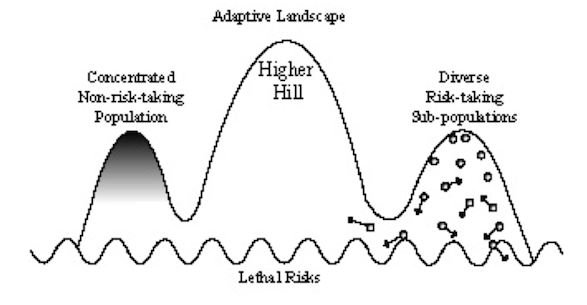
While there are clear distinctions between the fitness (or adaptive) landscape of genotypes and the stability landscape of social-ecological regimes, the earlier metaphor is analogous – and, to my mind, informative – to a discussion of regime change. Here’s why.

Consider Wright’s burning question. He sought to understand the process whereby populations might escape local peaks. Our current challenge is similar: how to break free from maladaptive regimes. Both landscapes illustrate the benefits of diverse and heterogeneous risk-taking – in poplar terms, of innovation. And, both landscapes are continuously evolving, both through extrinsic environmental forces and also through biological and social-ecological interactions. Change happens.

(Note that, while Wright’s work is widely cited in evolutionary biology, his metaphor has also faced criticism.) (5)

Background: Stability landscapes
The stability landscape metaphor can be traced back to the 60s and 70s work of biologists and ecologists Richard Lewontin, Buzz Holling, and others. Contrary to Wright’s landscape of convex peaks, alternative stable states were visualized as concave basins, sometimes called domains of attraction or simply: regimes. (6)

Since then, researchers have developed the stability landscape model and metaphor as a means of understanding ecosystem resilience and transformation. A regime shift occurs when a system crosses a threshold to another basin, like when a clear lake that is over-polluted with fertilizer runoff becomes filled with algae, or grassland that is overgrazed turns to woody shrub land or savannah.

The Stockholm Resilience Centre maintains global databases of such regime shifts and thresholds. Here is a short video describing the concept. (7)

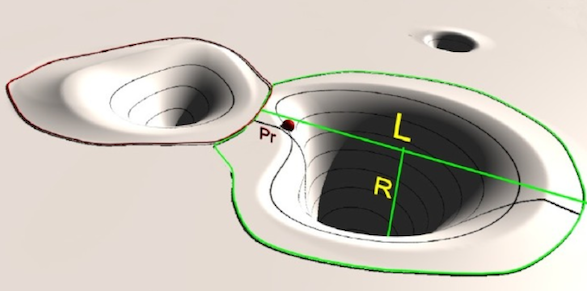
As shown below, regimes can be characterized by: their resistance (R) – their rigidity to change; their latitude (L) – the amount they can be changed without losing their structure, function, and identity; and their precariousness (Pr) – the distance of a social-ecological system to a regime threshold. (8 – figure 1)
Regimes and transformation
Development of a framework for transformation might begin by characterizing today’s landscapes of dominant and alternative (or niche) regimes. In the literature on transition management a regime is defined as “a coherent configuration of technological, institutional, economic, social, cognitive and physical elements and actors with individual goals, values and beliefs.” (9)

Questions that might be considered in such an examination include:

  • In what senses are today’s dominant or alternative regimes “coherent configurations”?
  • In what senses might regime resistance, latitude, or precariousness differ between, say, dominant food and energy regimes?
  • How did these regimes come into existence, at what spatial extents to they operate, and how do they – or might they, in the future – leave individuals, communities, and societies vulnerable?

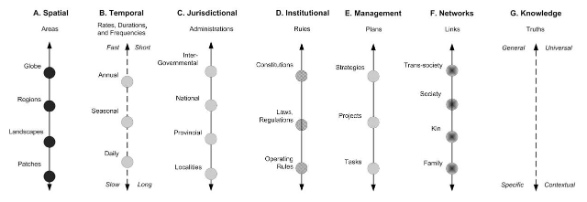
Critical to such system and regime characterizations are assumptions about scales and levels. Here is one approach to definition, taking scale to mean spatial, temporal, quantitative, and analytical dimensions and level to mean units of analysis on each scale. (10 – figure 1)
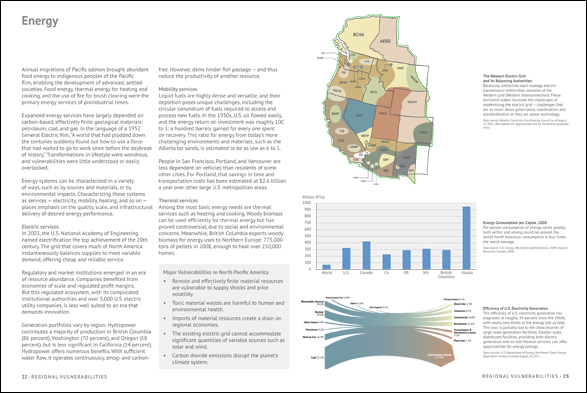
My Ecotrust colleagues and I explored these types of questions in the publication Resilience & Transformation: A Regional Approach (html, pdf, flash-based online viewer). We examined seven regimes of significance to our home region of North Pacific America. Here is an example page spread.
Moving forward
In sum, the regime landscape metaphor offers a systems approach to examining processes of social change.

Here are a few questions I plan to explore in my ISSS talk.

Your thoughts?

Notes
(1) Wright, Sewall. 1932. The Roles of Mutation, Inbreeding, Crossbreeding and Selection in Evolution. Proceedings of the Sixth International Congress of Genetics. http://www.esp.org/books/6th-congress/facsimile/contents/6th-cong-p356-wright.pdf

(2) Kauffman, Stuart. 1995. At Home in the Universe: The Search for the Laws of Self-Organization and Complexity. Oxford University Press. pp.149-189.

(3) Levin, Simon. 1999. Fragile Dominion: Complexity and the Commons. Helix Books / Perseus Publishing. pp.117-156.

(4) Ellerman, David. 2010. Pragmatism versus Economics Ideology in the Post-Socialist Transition. Real-World Economics Review 52:2-27. http://www.paecon.net/PAEReview/issue52/Ellerman52.pdf

(5) See, for example: Reiss, John. 2009. Not by Design: Retiring Darwin’s Watchmaker. University of California Press. pp.176-177. Also Levin, op. cit.

(6) Holling, C. S. 1973. Resilience and Stability of Ecological Systems. Annual Reviews: Ecology, Evolution, and Systematics 4:1-23. http://www.iiasa.ac.at/Admin/PUB/Documents/RP-73-003.pdf

(7) Regime Shift video by Kit Hill on Vimeo.

(8) Leuteritz, Thomas E. J. and Hamid R. Ekbia. 2008. Not All Roads Lead to Resilience: A Complex Systems Approach to the Comparative Analysis of Tortoises in Arid Ecosystems. Ecology and Society 13(1). http://www.ecologyandsociety.org/vol13/iss1/art1/

(9) Holtz, Georg, Marcela Brugnach, and Claudia Pahl-Wostl. 2008. Specifying “Regime” — A Framework for Defining and Describing Regimes in Transition Research. Technological Forecasting and Social Change 75:623-643.

(10) Cash, David W., W. Neil Adger, Fikret Berkes, Po Garden, Louis Lebel, Per Olsson, Lowell Pritchard, and Oran Young. 2006. Scale and Cross-Scale Dynamics: Governance and Information in a Multilevel World. Ecology and Society 11(2):8. http://www.ecologyandsociety.org/vol11/iss2/art8/
Ecologist Brian Walker calls the dynamic between resilience and transformation: “learning how to change in order not to change.” In other words, learning how to transform maladaptive regimes, for the greater resilience of human individuals and societies.

From the 2012 Krebs Lecture at the University of Canberra Institute for Applied Ecology (beginning at 21:15):

When a shift into some bad state has occurred, or when it’s clearly inevitable, then the only course of action is transformation into some new kind of system.

Change the nature of the system, change its defining variables — its identity — by removing one of the existing variables that define its identity, and introducing one or more new ones.

As an example, consider an irrigated farming region confronted with a drying climate. There is not enough water for irrigation, and this will shift it into a “bad basin,” unless it transforms.

It’s present defining variables that give it its identity are: water for irrigation, productive soils, certain crop types — is it irrigated for cotton or dairy, for instance?

Well, remove water for irrigation out of that system; change the crop type; build up the biodiversity and improve native habitats; increase the scale of operations — across private holdings, to groups of farms; introduce tourism — and we have a transformational change, a system with different defining variables and a different identity. …

Transformational change is facing much of the world today, from local levels up to the scaled of the globe. And the current energy and economic systems are prime candidates for transformational change.

From the work done thus far, effecting a transformation has three requirements:

First and foremost of all is getting beyond a state of denial. Nobody likes fundamental change. And individuals, communities, and societies will resist it as long as they can — often to a point where their options for a graceful transformation are gone. …

The second requirement for transformational change are the options for change. There may already be some, in some systems and cases. But more often than not, they have to be explored and created, through experiments and novel ventures.

Now, it’s really dangerous and difficult to experiment with a whole system, whatever the focal scale might be. So options and experiments are best developed through “safe” experiments at fine scales, or in partial, different ways.

And the success of this creative, innovative part of the process — trying new things out to see what could become another way of living — depends very much on the third requirement, which is the capacity to change.

Occasionally it might be inherently high. But most often and especially when it’s most needed, transformation requires help from the scales above, support by government or other bodies to try novel things, or financial help to start new ventures.

All too often this higher level support is distorted by an obtuse set of limitations that amount to help not to change, rather than help to change.

Governments that are opposed to decentralization, and that operate on a one-size-fits-all basis give help to keep systems performing in the same way. And they have restrictions on what novel things can be tried. Or the nature of the help they offer is shaped not by what’s needed locally, but by other political imperatives. …

These three components of transformability … are difficult to orchestrate in the face of rapid change, especially.

Source: video 20 FEB 2012