The core of the Marshall Plan was “an enormous sovereign debt relief programme,” writes Albrecht Ritschl, professor of economic history at the London School of Economics, in The Economist (“Germany, Greece and the Marshall Plan“).

The Marshall Plan had an outer shell, the European Recovery Programme, and an inner core, the economic reconstruction of Europe on the basis of debt forgiveness to and trade integration with Germany. The effects of its implementation were huge. While Western Europe in the 1950s struggled with debt/GDP ratios close to 200%, the new West German state enjoyed debt/ GDP ratios of less than 20%. This and its forced re-entry into Europe’s markets was Germany’s true benefit from the Marshall Plan, not just the 2-4% pump priming effect of Marshall Aid. …

Europe should learn from history. But it needs to learn fast. There might be no recovery unless debts are reduced to manageable proportions. That is what ended the Great Depression in Europe in the 1930s, and that is what in all likelihood is needed again.

H/t: Merijn Knibbe in Real World Economics Review Blog

“Much of what is taught in the graduate schools of economics is wrong,” says Nobel Memorial Prize winning economist Joseph Stiglitz.

I think I would still study economics. I still think that economics is essential to improving living standards and reducing poverty.

But I would modify that in two ways.

First, much of what is taught in the graduate schools of economics is wrong. In many graduate schools they still teach versions of the Washington Consensus — the policies that have proven themselves wrong. Economists contributed to wrong concepts that played a role in the economic downturn and the economic crisis. So I would caution students to listen with some skepticism to what their economic professors say and to choose the right school. If you choose the wrong school, you may get the wrong ideas.

The second thing is that I am more convinced today of the importance of studying politics, sociology, broader perspectives on social sciences — that all of these are mixed together, and that studying economics in isolation from the other social sciences is wrong.

Source: video posted 15 JUN 2012 by World of Business Ideas

Arthur Lupia: Formula for Credibility

Political scientist Arthur Lupia gave one of the keynote talks at the National Academy of Sciences colloquium on social science research in science communication.

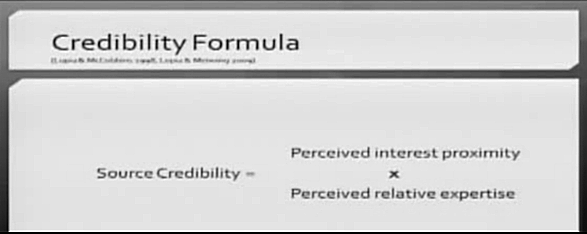
This part caught my attention (beginning at 23:50), which Lupia summarizes with the credibility formula above:

The key thing to know about credibility is that it is domain specific and bestowed by an audience.

Here’s an example: Most people in the room probably think that Mercedes makes a fine automobile. They have a reputation for fine automobiles. But would you buy a Mercedes breakfast cereal? What would that taste like? Would it be high quality or would it taste like German motor oil?

So there’s credibility in one domain but not in another. You might be credible as a scientist, but if you don’t share people’s values, are they really going to believe you? …

There have been moments in my career when I have been approached by faith leaders. And the question’s been asked: How should I write a sermon about climate change?

And the advice that I give is: I wouldn’t. Because you are not credible as a scientist.

But what you do know, if you’ve been doing this for a long time is that you have some sermons where you know that the whole congregation is there with you. And they reach the apex with you. And you’re talking about shared values.

Do you have a sermon where you talk about responsibility, where you talk about stewardship, where you talk about shared values? Right when you reach the apex, and everybody’s with you in terms of attention, you say: If we all believe in stewardship and responsibility, then climate is part of what we’re responsible for as well.

Update: Arthur Lupia mentions his book The Democratic Dilemma: Can Citizens Learn What They Need to Know? as background for this research.

Source: video (May 21-22, 2012)

Lin Ostrom: We can do it!


One thing I’ll always remember about Elinor Ostrom: her indomitable spirit.

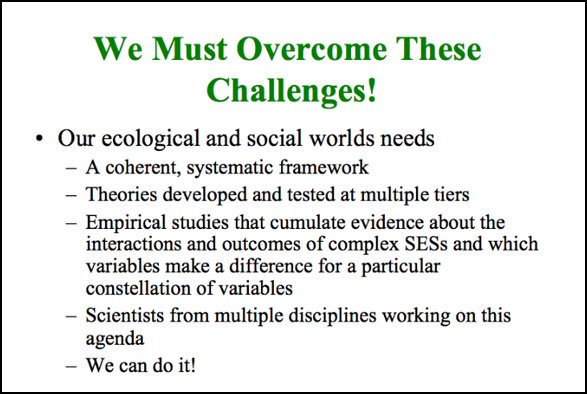
This was the closing slide of her 2007 talk at the AAAS (American Association for the Advancement of Science) annual meeting.

Her words were:

And the last big challenge is one that I consider very important: recognizing the value of institutional diversity. We need to get away from simple policy solutions.

When I’ve actually coded the rule systems that are used, I found things like 35 boundary rules in one region, combined with 25 information rules, combined with so many appropriation rules, etc.

It’s like a gene. It is a very long string of instructions that people have devised. And we need to study that, understand it, and look at it over time. We must recognize and understand institutional diversity.

A lot of people want to eliminate it. The criticism is: oh there are so many units and get rid of them. Then we get rid of all the little snails and bugs and mosquitoes and other things. Right now that wouldn’t be politically acceptable to say that we should get rid of all the little insects of the world. I hope we get to the point it’s not politically acceptable to get rid of all the institutional diversity.

Ok, so, we must — I’m coming from the 60s; we must overcome! — we must overcome these challenges.

Our ecological and social worlds need a coherent systematic framework. We need theories developed and tested at multiple tiers; we need empirical studies that can cumulate.

We need scientists who work together. And we can do it!

(Any errors in transcription are my own.)

Daniel Kahneman’s fiction


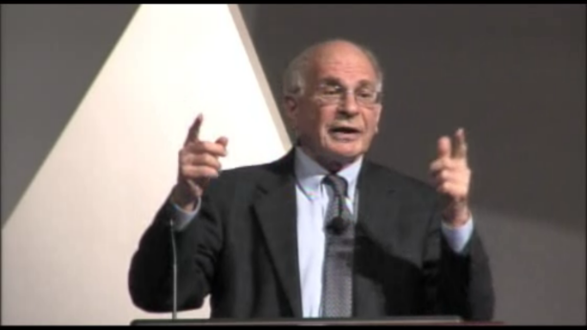
Psychologist Daniel Kahneman wraps up his talk at the National Academy of Sciences colloquium on social science research in science communication by stating that he has presented “a fiction.” And it is a fascinating yarn he’s spun.

Summarizing the main threads of his new book Thinking, Fast and Slow, Kahneman describes “a psychodrama with two characters”: System 1 thinking and System 2 thinking.

“When we think of ourselves,” he writes:

[W]e identify with System 2, the conscious, reasoning self that has beliefs, makes choices, and decides what to think about and what to do. Although System 2 believes itself to be where the action is, System 1 is the hero of the book.

System 1 is intuitive, instinctive, automatic, emotional, and associative. System 2 is deliberate, specific and detailed. System 1 handles the commonplace and familiar motions of driving a car. System 2 takes over when facing a left turn into oncoming traffic.

A couple of passages that caught my attention.

There is a key difference between associations and inferences. Order and sequence are essential to inferences … associations are symmetric. … If a disgusting word is mentioned … you feel disgusted and you make a disgust face. If you shape people to make a disgust face, they will feel disgusted. So it really works both ways. … This is just one example out of many of the symmetry we find in associations, and it’s the same symmetry that we find between arguments and conclusions. Things work both ways, in many cases. … Scientists normally think of coherence as logical coherence … if a then b. There is another kind of coherence, which is associative and emotional coherence. It’s not sequential. The model for it is the coherence of a network. Ideas that support each other are reinforced; other ideas are inhibited. And what you have is a solution that is a coherent solution … associatively and emotionally. (Beginning at 26:20.)

This is the story I have to tell you. I think there are two ways of believing and knowing. And there are two ways of achieving coherence: logical coherence and associative or emotional coherence. And we tend to believe that we are system two, because that’s what we are conscious of, but in fact most of what we are doing is dictated – and, usually, very appropriately – by an associative system, over which we have very limited control. And that has profound implications for the way we ought to talk to people. (Beginning at 52:45.)

Source: video (May 21-22, 2012)

Barrett Brown: Four Universal Perspectives

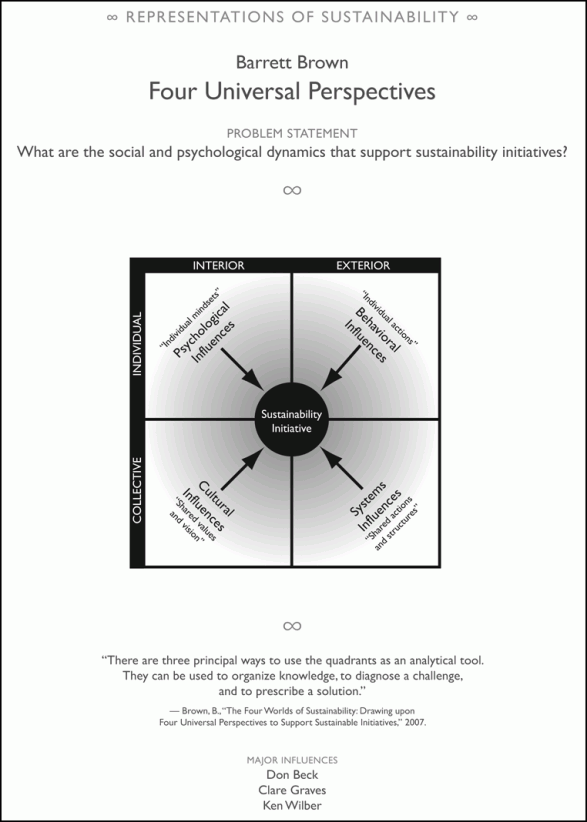
“Representations of sustainability” was a concept I developed for a series of posters displayed at the 2009 opening of the SEA Change Gallery in Portland.

This one featuring Barrett Brown’s four universal perspectives is based on his paper, “The Four Worlds of Sustainability” (pdf).

Poster design by Andrew Fuller.

Bob Inglis: A revenue-neutral tax swap

“What we’re after is a conservative definition of sustainability,” declares former-Congressman Bob Inglis, Republican from South Carolina.

And why not? After all, conservative and conservation have much in common, theoretically.

Inglis calls his proposal a revenue-neutral tax swap: Remove all energy subsidies, and attach all costs to energy products. He’s been touting the tax swap idea since his days in the House (2009 video) and, this past January, joined the Cures for Climate Confusion Town Hall event held at the University of Michigan (video).

From an interview with Inglis in the U Michigan conference publication, “Increasing Public Understanding of Climate Risks and Choices” (pdf):

Q: What have you taken from this conference so far?
A: One thing I have learned in this conference is to start with a point of agreement and then to move from there. For example, in trying to reach conservatives on the need to prepare a conservative solution on energy and climate, we should assume that they want to be a solution agent and that our shared philosophy can help to solve the challenge. And I think it can, since a key value for many different types of conservatives is accountability. If you just focus on that key value, everyone can contribute to the discussion.

A few notes:

  • Inglis’ proposal (~58:00 on the U Michigan video): Reduce payroll taxes. Shift the tax to CO2 at $15 per ton, rising to $100 per ton over 30 years. Make it a border-adjustable tax that is removed on export, imposed on import, so it wouldn’t decimate American manufacturing.
  • Some or many U.S. military activities are, in effect, subsidies to the petroleum industry; the Price-Anderson Act is, in effect, a subsidy to the nuclear industry.
  • This type of market-based approach wouldn’t, by itself, engender large-scale infrastructure projects such as intercity high-speed rail.
  • Interestingly, at the Climate Change Open Forum I joined last week, one self-identified “climate skeptic,” who was wearing a Cato Institute jacket, sketched out a proposal very similar to this one by Inglis.
  • (Update): Jerry Taylor summarizes the arguments against carbon taxes in a 2008 post at Cato@Liberty, quoting energy economist Stephen Smith: “Only if there are expected to be environmental gains can the use of environmental taxes be justified, and the case for ecotax reform must be made primarily on the basis of the environmental gains that would result.” Indeed. Social and environmental gains.

Curtis White: Philanthropy as risk management

The revolution will not be funded, goes the refrain.

In “The Philanthropic Complex,” published in the spring 2012 issue of Jacobin, Curtis White takes a tour through the world of American environmental funding. For anyone who has read, say, Mark Dowie’s Losing Ground: American Environmentalism at the Close of the Twentieth Century and American Foundations: An Investigative History, it’s a familiar critique. But one worth a revisit.

In the fall of 2009 I was approached by Hal Clifford, executive editor of Orion Magazine, and asked to write an essay about American philanthropy, especially in relation to environmentalism. From the first I was dubious about the assignment. I said, “Not-for-profit organizations like you cannot afford to attack philanthropy because if you attack one foundation you may as well attack them all. You’ll be cutting your own throat.”

Hal assured me that while all this might be true someone had to take up the issue, and Orion was willing to do so. And I was the right person to write the essay precisely because I was not an insider but simply an honest intelligence. So, with many misgivings I said I’d try.

I interviewed about a dozen people on both sides of the field, both givers and getters, and some in the middle. The people I spoke to were eager to articulate their grievances even if they were just as eager to be anonymous. I also should acknowledge that the development of these grievances was no doubt colored by my own experiences as a board member and president of the board of two not-for-profit organizations in the arts.

After working for several months writing and revising the essay, Hal Clifford announced that he would be leaving Orion. My first thought was “uh-oh.” The editor-in-chief, Chip Blake, took over my essay and at that point things got dicey. Ultimately he explained that he hadn’t been fully aware of my assignment, that he hadn’t known the essay would be an attack on “the oligarchy,” that it didn’t seem to be fully a part of the magazine’s usual interests, and that–fatally–from the magazine’s point of view publishing the essay would be an exercise in “self-mutilation.”

Commitment on salt

Gary Taubes writes in the NYT, “Salt, We Misjudged You”:

“You can say without any shadow of a doubt,” as I was told then by Drummond Rennie, an editor for The Journal of the American Medical Association, that the authorities pushing the eat-less-salt message had “made a commitment to salt education that goes way beyond the scientific facts.”

Acknowledging skepticism and denial

A growing field of research and writing explores the nature of climate change skepticism and denial.

There is the Six Americas study of ways in which Americans engage with the issue. There are a variety of research programs related to the Cultural Theory typology of people as having hierarchist, individualist, egalitarian, and fatalist tendencies. And there are surveys of cognitive and behavioral challenges to climate change perceptions, like the one developed by Kari Marie Norgaard. I wrote about each of these topics and more at P&P.

“Let’s bring together people with divergent views on climate change,” announced the Climate Change Open Forum website. The forum happened last weekend in Portland, with a series of discussions around the city. I spoke briefly at the Saturday evening session, which succeeded in attracting a sizable, diverse audience.

In preparing for my talk, I thought about the common labels for climate action contrarians: skeptic and denier. I wanted to explore my own areas of skepticism and denial. After all, one can recognize the strength of the core science — like the Intergovernmental Panel on Climate Change (IPCC) Working Group I research on observation and attribution — and still hold a variety of feelings on climate change.

So I asked myself: In what ways am I skeptical? What are my own denials and what denials do I encounter in others?

This seems to me like a valuable exercise, and at the beginning of my talk I encouraged everyone in the audience to engage in his or her own critical reflection. With more time, I would design this type of session to allow for break-out discussions and full-group harvest on these questions.

In my experience with these types of conversations, the denials that often come up are the ones related to personal habits. Am I doing enough in the way I live my life? For example and for myself, I ride my bike most days, but I still eat meat.

In the charged atmosphere of the Open Forum, and without the opportunity to each explore our own denials, the sense of denial surfaced as an accusation of hypocrisy. An audience participant pointed out that numerous folks urging climate action had flown into town for the event. Implications of denial can easily open Pandora’s box.

To get beyond the area of individual habits, think of the question about denial as a fill-in-the-blank exercise, one that goes like this: “We are in denial if we think that __________.”

Here are a couple that come to mind for me:

  • We are in denial if we think that research in the natural sciences can ever prescribe a clear plan of global climate action.
  • We are in denial if we think that there will be solutions to climate change, in any usual sense of that word.

Skepticism is a very different from denial. Skepticism is crucial to good science and a perspective for evaluating potential policy or other engagements. And, just as importantly, it’s a perspective for designing engagements as experiments — that is, as opportunities for learning and adaptation.

On the climate issue, if you dig into some of the most outspoken skepticism about the claims of climate scientists, often what you’ll find underneath is skepticism about potential policies. Nothing surprising about that. We are all vulnerable to such fact-value entanglements, even if some scientists are able to maintain a purely professional stance.

The trick is to not let skepticism become an impediment to action. Quite the contrary, as I noted, skepticism is critical to effective action.

Here are a few examples of my own skepticism:

  • Although the Earth’s atmosphere is a global commons, I am skeptical that deliberations about mitigation necessarily need to take place at a global level. It may be that today’s most significant conversations take place within cultural and physical contexts, where appropriate needs and inter-personal understandings are better negotiated.
  • I am skeptical that any global mechanism for ratcheting down emissions — even the best conceived ones, like the Greenhouse Development Rights framework — would function entirely as intended.
  • I am skeptical that any combination of primary energy sources — like sun and wind and geothermal — will ever be able to truly substitute for the energy supplied by energy-dense fossil fuels.
  • I am skeptical that we can comprehend what it feels like to be caught in the maelstrom of a major evolution of worldviews or paradigms, which seems to be what is happening.

These are my acknowledgements of skepticism and denial.

Your turn. What are you skeptical or in denial about?

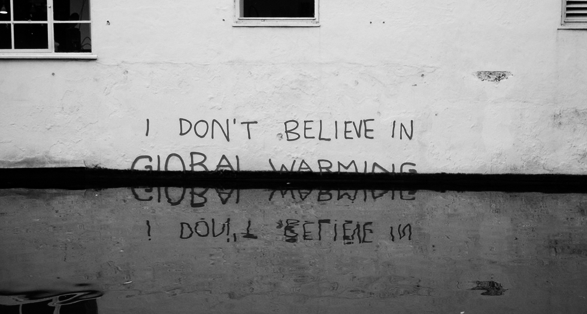
Photo: graffiti attributed to Banksy at Regent’s canal, north London, from a photo by Mangus D