Four dimensions of crowdfunding

JOBS Act or not, crowdfunding platforms and opportunities are evolving rapidly. How might we better understand the crowdfunding ecosystem — what’s out there, what’s promised, and what might be missing?

Here are four dimensions for consideration.

Payback: What’s the nature of the exchange?

A May 2012 crowdfunding.org global industry report distinguishes four kinds of platforms: donation-based, reward-based, lending-based, and equity-based. Examples include Kickstarter for rewards, ioby for donations, Kiva for lending, and Fundrise and FundersClub for equity.

(Fundrise and FundersClub have each qualified under existing U.S. regulations and gotten ahead of the Securities and Exchange Commission’s JOBS Act ruling. On whether rules will be formulated by the Act’s end-of-year deadline, WaPo and Forbes commentators seem bullish, others less so.)

Curating: Are projects filtered or accredited for inclusion?

Kiva curates; Kickstarter is largely buyer beware. Fundable yes; Indiegogo not so much.

Impact: How significant is the project?

There are of course a lot of ways to think about impact. Ethan Zuckerman takes up the topic of civic engagement in last week’s “How Do We Make Civic Crowdfunding Awesome?

He voices the concern that if crowdfunding becomes commonplace for what-were-once-considered public goods, such as public transportation infrastructure (e.g., on neighbor.ly) or public street or park maintenance (e.g., on ioby), then it might undermine, rather than strengthen, the social contract. This article is really worth a read.

In order to explore further, let’s take a case from my hometown of Portland, Oregon. Brief summary of a long story: Columbia Biogas wants to build a factory to turn food waste into biogas. Great project. Sought leverage funding to guarantee its loans. Portland City Council indicated some support but then backed off. The company was subsequently able to secure private financing. Personally, I’d support an active government role in this instance (and Ecotrust did support it), while also acknowledging that cases of business financing may be more complicated than those involving public goods like public transportation or parks.

Now let’s imagine that companies like Columbia Biogas could turn to crowdfunding. What might the platform look like? Lending or equity platforms like these could start to resemble the local stock exchanges that Michael Shuman has been advocating. He cites the example of Wyoming’s Powell Mercantile, a clothing store founded in 2002 on a local stock offering. Regional exchanges are in various stages of discussion and development by SVX in Ontario, LanX in South Central Pennsylvania, and Friends of the Hawaii Local Exchange.

Which leads to the last dimension: local-global.

Local-Global: How local or global is the platform’s ecosystem?

Kiva is fundamentally global. Regional exchanges like Ontario’s SVX aim to inhabit the other end of the spectrum. Still others like ioby follow the Craigslist playbook: Start in one place — SF for Craigslist, NYC for ioby — and then scale out.

Does place matter when it comes to crowdfunding ecosystems? For project listings like Columbia Biogas, would the development of local-regional exchanges enable trust building and provide credibility in ways that nationwide platforms could not?

I’ll leave this post here and welcome your thoughts.
Education for the head, hands, and heart

Benjamin Bloom: head, hands, and heart
What comes to mind when you hear the phrase “head, hands, and heart”?

Waldorf-style teaching programs? Maybe the sign of the cross?

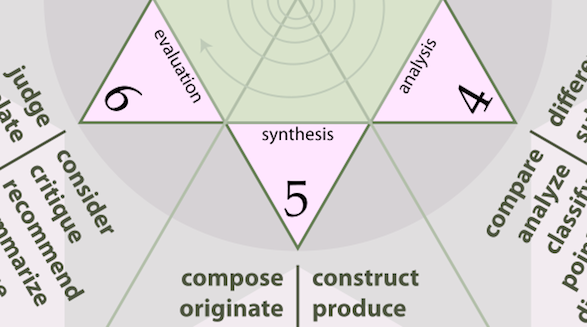
How about a taxonomy of learning objectives — cognitive, psychomotor, and affective — whose development by educational psychologist Benjamin Bloom traces back to 1956?

This latter was new to me, a source I discovered in the 2008 paper, “Achieving transformative sustainability learning: engaging head, hands and heart.”

Intriguing framework. Image of Bloom’s Taxonomy from Wikimedia Commons. More on Bloom’s Taxonomy from Don Clark.

Key competencies in sustainability

What are the “complexes of knowledge, skills, and attitudes that enable successful task performance and problem solving with respect to real-world sustainability problems, challenges, and opportunities”?

These “complexes of knowledge, skills, and attitudes” are what Arnim Wiek, Lauren Withycombe, and Charles Redman of Arizona State University’s School of Sustainability call, in a 2011 paper, “Key competencies in sustainability: a reference framework for academic program development.”

Semantics aside — I’m among those that would (in a future post) noodle further on the word competence  — the authors, from a review of 43 relevant documents, develop an intriguing list: systems-thinking competence, anticipatory competence, normative competence, strategic competence, and interpersonal competence.

Their definitions:

Systems-thinking competence is the ability to collectively analyze complex systems across different domains (society, environment, economy, etc.) and across different scales (local to global), thereby considering cascading effects, inertia, feedback loops and other systemic features related to sustainability issues and sustainability problem-solving frameworks.

Anticipatory competence is the ability to collectively analyze, evaluate, and craft rich ‘‘pictures’’ of the future related to sustainability issues and sustainability problem-solving frameworks.

Normative competence is the ability to collectively map, specify, apply, reconcile, and negotiate sustainability values, principles, goals, and targets.

Strategic competence is the ability to collectively design and implement interventions, transitions, and transformative governance strategies toward sustainability.

Interpersonal competence is the ability to motivate, enable, and facilitate collaborative and participatory sustainability research and problem solving.

More on education.

Etienne Wenger on education

With thoughts turning to education, a few notes from the last chapter of Etienne Wenger’s 1998 book, Communities of Practice:

Education, in its deepest sense and at whatever age it takes place, concerns the opening of identities — exploring new ways of being that lie beyond our current state. …

To the extent that knowledge is reified, decontextualized, or proceduralized, learning can lead to a literal dependence on the reification of the subject matter, and thus to a brittle kind of understanding with very narrow applicability. …

[T]eaching does not cause learning: what ends up being learned may or may not be what was taught, or more generally what the institutional organization of instruction intended. …

If an institutional setting for learning does not offer new forms of identification and negotiability — that is, meaningful forms of membership and empowering forms of ownership of meaning — then it will mostly reproduce the communities and economies of meaning outside of it.


Climate regulation and requisite variety

If a photographer wants to capture twenty images, and the subject of each image requires a distinct combination of focus and exposure, then the camera must have available at least twenty distinct settings.

This example of requisite variety comes from Ross Ashby‘s 1956 book An Introduction to Cybernetics (pdf download from Principia Cybernetica).

At the core of Ashby’s writing is the question of regulation. How do biological organisms, social organizations, or — in this case — mechanical artifacts regulate for their environments? They must have sufficient diversity or variety. Thus: “Only variety absorbs variety.”

I’ve been reading Ashby with one eye to experiences with climate regulation. From an Ashbian perspective, we might interpret this week’s NYT front-page report on carbon credits functioning as perverse incentives as an example of regulations that have had insufficient variety to cope with the variety of responses. (For reports that have found European climate regulations successful, see “The European Carbon Trading (EU ETS) Experience” and “Insights from the European Union Carbon Market.”)

A few notes from Ashby’s text:

11/2. The subject of regulation is very wide in its applications, covering as it does most of the activities in physiology, sociology, ecology, economics, and much of the activities in almost every branch of science and life. Further, the types of regulator that exist are almost bewildering in their variety. However, we shall be attempting to get at the core of the subject — to find what is common to all.

12/1. Before any regulation can be undertaken or even discussed, we must know what is important and what is wanted. Any particular species has its requirements given — the cat must keep itself dry, the fish must keep itself wet. A servo-mechanism has its aim given by other considerations — one must keep an incubating room hot, another must keep a refrigerating room cold.

13/2. Regulation in biological systems certainly raises difficult problems — that can be admitted freely. But let us be careful, in admitting this, not to attribute the difficulty to the wrong source. Largeness in itself is not the source; it tends to be so regarded partly because its obviousness makes it catch the eye and partly because variations in size tend to be correlated with variations in the source of the real difficulty. What is usually the main cause of difficulty is the variety in the disturbances that must be regulated against.

From management consultant and theorist Gareth Morgan, in 1997’s Images of Organization:

The principle of requisite variety, originally formulated by the English cybernetician W. Ross Ashby, suggest that the internal diversity of any self-regulating system must match the variety and complexity of its environment if it is to deal with the challenges posed by that environment. Or to put the matter slightly differently, any control system must be as varied and complex as the environment being controlled. …

[Requisite variety] suggests that redundancy (variety) should always be built into a system where it is directly needed rather than at a distance. … The principle suggests that when variety and redundancy are built at a local level — at the point of interaction with the environment rather than at several stages removed, as happens under hierarchical design — evolutionary capacities are enhanced.

I’m reminded of the subsidiarity principle or the so-called “clumsy climate strategy,” which includes the principle: Deal with issues at lowest possible level of decision making — nations, provinces, cities.

On Ashby’s law, see also this 1990 talk by fellow cybernetician Stafford Beer:

Todd Gilens: Discourse on shade

What does the shade of understory *look like* from the point of view of a a sprouting plant?

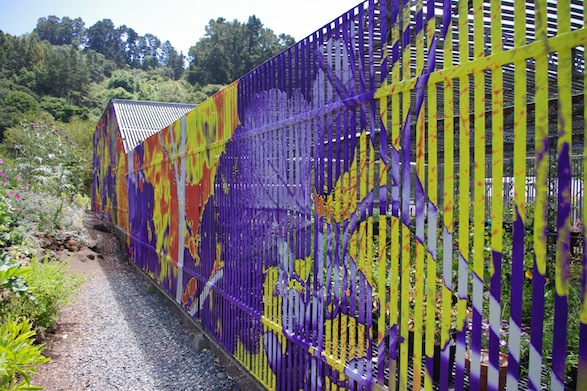
This question provides a starting point for the latest project by Todd Gilens. Called “Shade,” it’s on view through January 2013 as part of the Natural Discourse exhibition at the UC Berkeley Botanical Garden.

Todd has created a series of large-scale public artworks in which the perspective and habitat of the viewer collide with those of other species, including sprats at Stockholm University and butterflies on the streets of San Francisco.

The recent botanical garden project turns a lath house into a space for dwelling on the effects of shade. Lath houses — or shade houses — are slatted structures that modulate temperature and moisture, simulating the effects of understory for the young plants housed inside. In Todd’s vision for the east face of this building, our perspective becomes that of the sprout.

I first saw Todd’s art at the Stockholm Resilience 2008 conference, which I followed remotely. We met soon after, and I recently had a chance to record him talking about his new work. “It seems to me that shade is a condition itself ,” he says. “It’s a combination of two extremes — and, in combining them, provides a unique condition where things can happen.”

Unfortunately, my video is itself a bit shady…


Water dialogues: Voices from the Klamath

“This is the time I was challenged the most in my life and grew the most in my life,” reflects Klamath Tribal Council Vice Chairman Don Gentry (~35:15).

Gentry spoke at an open and candid May 2nd panel at Portland State University, hosted by PSU’s Institute for Sustainable Solutions and Sustainable Northwest, a Portland-based nonprofit that has been working in the Klamath Basin. Other panelists were Erica Terrence of the nonprofit Klamath Riverkeeper; Becky Hyde, a rancher with the Country Natural Beef coop; and Glenn Spain of the Pacific Coast Federation of Fishermen’s Association.

A (very) brief timeline:

  • 2001: In drought conditions, the Bureau of Reclamation reduces irrigation water to farmers and ranchers. (“The fundamental problem [is] that the Klamath Basin is an overstressed ecosystem in which there are too many claimants for too little water” — NYT editorial).
  • 2002: Over 30,000 salmon die in the Klamath River, due in part to low water flows. (“Simply put, there isn’t enough water in the sprawling but arid watershed to serve both fish and farmers optimally.” — in SF Chronicle.)
  • 2010: Two agreements signed: the Klamath Basin Restoration Agreement and Klamath Hydroelectric Settlement Agreement.

For anyone interested in the Pacific Northwest, or in water and watershed issues, or in environmental conflict resolution, this video is really worth a watch.

Here’s rancher Becky Hyde (~1:01:00):

I have a short story that kind of symbolizes what these agreements mean to me, and it came long before these agreements even came about.

In — probably about — 2005, there was a series of meetings that went over about an eight-month period. And it was the first time that, just in the upper basin, the highly divided ag community and the tribal community came together.

And just to be in the room together — there were people outside protesting these meetings, just because there were people in the room together.

And there were about seven or eight farmers and five tribal people. And we were visiting one day, and we had started to look at numbers. We would spend hours and hours looking at very confusing graphs. If these people got this much water, and the lake fish got this much water, and the farmers got this much water, and the fish downstream got this much water, how much water would that be? Honestly, you have no clue. Most people like me don’t even understand these numbers.

We were sitting around one day, and I think it was comforting for a while to be in numbers. And the farmers were trying to grapple with the idea that these people (the tribes) have suffered a huge loss.

So there were some farmers in the room that were suddenly realizing: They (the tribes) lost their fishery.

So, how do we fix that? Well, we could pay you. How many fish did you lose? We could put a number on that fish. And we could pay you.

I don’t want it to sound funny. What I want to come across is how human this is. It was a first step toward an act of kindness. How do we fix this?

The former chair of the Klamath Tribes was in the room, and i looked at him and said: What would it mean to the tribes if we just said we’re sorry.

He started to cry, and he said: It would be worth a million dollars.

Then, one of the farmers went home that night to Tulelake and was in a bar and shared this story with another farmer — and ended up in a bar fight of some sort …

Imagine then, a certain amount of your leadership getting it. And then imagine some of your community not getting it — and actually staying really angry, which is kind of where we are today.

Congressional action is still required for parts of the Agreements. From the governmental website:

Some aspects of the KBRA [Klamath Basin Restoration Agreement] require Congressional action, but the federal agencies also have existing authorities to implement some provisions.

For more information see:

Citizen science in 2012

“The task is to make visible the invisible, to expose to public scrutiny the assumptions, values and visions that drive science,” wrote James Wilsdon and Rebecca Willis in “See-through Science: Why public engagement needs to move upstream,” a 2004 publication from the UK think-tank Demos.

With the 2012 Public Participation in Scientific Research (PPSR) conference in Portland, and before I head out to catch a couple of talks, I scanned this month’s open-access issue of Frontiers in Ecology and the Environment, devoted to citizen science.

From “The history of public participation in ecological research”:

Categories of public participation in scientific research
Contributory — Generally designed by scientists and for which members of the public primarily contribute data; also includes studies in which scientists analyze citizens’ observations, such as those in journals or other records, whether or not those citizens are still alive
Collaborative — Generally designed by scientists and for which members of the public contribute data but may also help to refine project design, analyze data, or disseminate findings
Co-created — Designed by scientists and members of the public working together and for which at least some of the public parti- cipants are actively involved in most or all steps of the scientific process; also includes research wholly conceived and implemented by amateur (non-professional) scientists

From “Key issues and new approaches for evaluating citizen-science learning outcomes”:

We suggest that, in addition to considering social and community benefits, evaluation of citizen-science programs may help foster resilience – i.e. the capacity of a system to absorb shocks yet maintain function (Folke 2006) – in the interconnected ecological and social (socio-ecological) system. Key to resilience is this collective system’s capacity for learning and adaptation (e.g. understanding how ecological and social systems respond and adapt to climate change and making management choices; Walker et al. 2002). When learning about an ecological system and its associated social institutions (e.g. policies, management practices) through citizen science, a group of individuals gains collective knowledge that increases the capacity of the socio-ecological community to reorganize and adapt to changes.

From “The future of citizen science: emerging technologies and shifting paradigms”:

Citizen-science projects may evolve to address both local issues and grand societal challenges. Wireless sensor networks may connect the laboratory to the natural environment, shifting the focus from elite science to a reality where data collection, analysis, and interpretation are performed by everyday citizens going about their daily lives in partnership with professional scientists. A daily bicycle commute could automate air-quality monitoring; gardens could become networked micro-environment monitoring stations; data integration, visualization, and analyses could no longer require difficult file-format conversions; and scientists could more easily integrate continental-scale citizen-science datasets with professional datasets that are augmented by locally relevant citizen observations.

For more on citizen science, as related to internet-mediated participation, social learning, and resilience, see this post and comment thread.

For the challenges of ecoinformatics, see this post.

Jerry Michalski: Education as embracing agency

“I no longer believe that there is teaching,” says pattern finder and technology advisor Jerry Michalski. “There is no teaching; there is just learning.”

In a whirlwind (and “blunt”) talk at the Rebuild21 conference, Jerry covers a range of alternative educational theory and practice — from John Taylor Gatto, to unschooling and deschooling — as well as innovation in the dominant institutions that comprise the “compulsory school system.”

This caught my attention: “What we really want is for kids to have again a sense of agency.” He variously describes agency as: permission; the ability to do something, to act on something; a sense that it’s ok to go out and change your world, to try to make a difference; a responsibility for the task at hand.

Good stuff. I’ve similarly written about the local food movement as a story of embracing a sense of agency over our food choices.

Jerry’s post on the talk, with additional links, is here.

Carbon bubble – a $20 trillion write-off?

Perhaps the most chilling observation in Bill McKibben’s Rolling Stone article is that large quantities of climate-disrupting fossil fuels have already been factored into financial projections. The logic of finance creates into own realities, which are not easily discounted.

Yes, this coal and gas and oil is still technically in the soil. But it’s already economically aboveground – it’s figured into share prices, companies are borrowing money against it, nations are basing their budgets on the presumed returns from their patrimony.

As McKibben describes, these calculations include fuels that — given scientific understanding of radiative forcing — are expected to push global temperatures past a 2°C increase. Keeping them in the ground offers the best hope of relative climate stability.

But according to calculations by John Fullerton of The Capital Institute, not extracting these fuels would mean a financial write-off of $20 trillion — deflating a massive carbon bubble.

Starting with the July 2011 report “Unburnable Carbon” from the Carbon Tracker Initiative:

[U]sing just the reserves listed on the world’s stock markets in the next 40 years would be enough to take us beyond 2°C of global warming. This calculation also assumes that no new fossil fuel resources are added to reserves and burnt during this period – an assumption challenged by the harsh reality that fossil fuel companies are investing billions per annum to find and process new reserves. … In addition, over two-thirds of the world’s fossil fuels are held by privately or state owned oil, gas and coal corporations, which are also contributing even more carbon emissions.

From Fullerton’s October 2011 Guardian article, “The big choice: money or planet?”:

A cap on carbon emissions designed to limit warming to two degrees will mean sovereign states and public corporations must strand 80% of their $27tn of proved reserves and related assets, a loss exceeding $20tn.

If we incur a write-off of this magnitude, the risk that our fragile and interconnected global economy would collapse is high. …

The portion of the $20tn cost potential that will be written off depends upon unknowable developments in carbon sequestration technology. Prudence suggests that we should plan on incurring at least half of this potential loss, and get serious about developing and implementing policies to limit carbon pollution.

From Fullerton’s blog last week, “Financial Overshoot”:

Thus civilization is facing our $20 trillion big choice–our investments or our planet. Recall the direct financial losses of the subprime crisis in the US were a mere $2.7 trillion, and we know what that did.

[Bill McKibben’s] cover story this week in Rolling Stone, “Global Warming’s Terrifying New Math,” is a powerful expansion of this thesis, again built on the Carbon Tracker Report, and naming the fossil fuel industry as the enemy in the war on climate change.  Unfortunately, if the fossil fuel industry is the enemy, then the enemy must include the fossil fuel rich sovereign States themselves that account for 76% of proved reserves.

A few notes:

  • Some are less sanguine than Fullerton about carbon capture and storage technologies. Even if such technologies prove feasible, they would certainly reduce energy return on energy investment, and also require calculations of carbon return on carbon investment, meaning the net gain, given the amount of carbon emitted in technology development, production, and operation.
  • As to McKibben’s insistence on naming enemies, Fullerton demurs, as I did (“Humanity’s carbon budget”).
  • It becomes clear, yet again, that effective responses to a changing climate will depend on a complete overhaul of existing institutions. As we’ve heard it said, “Civilization needs a new operating system.”